
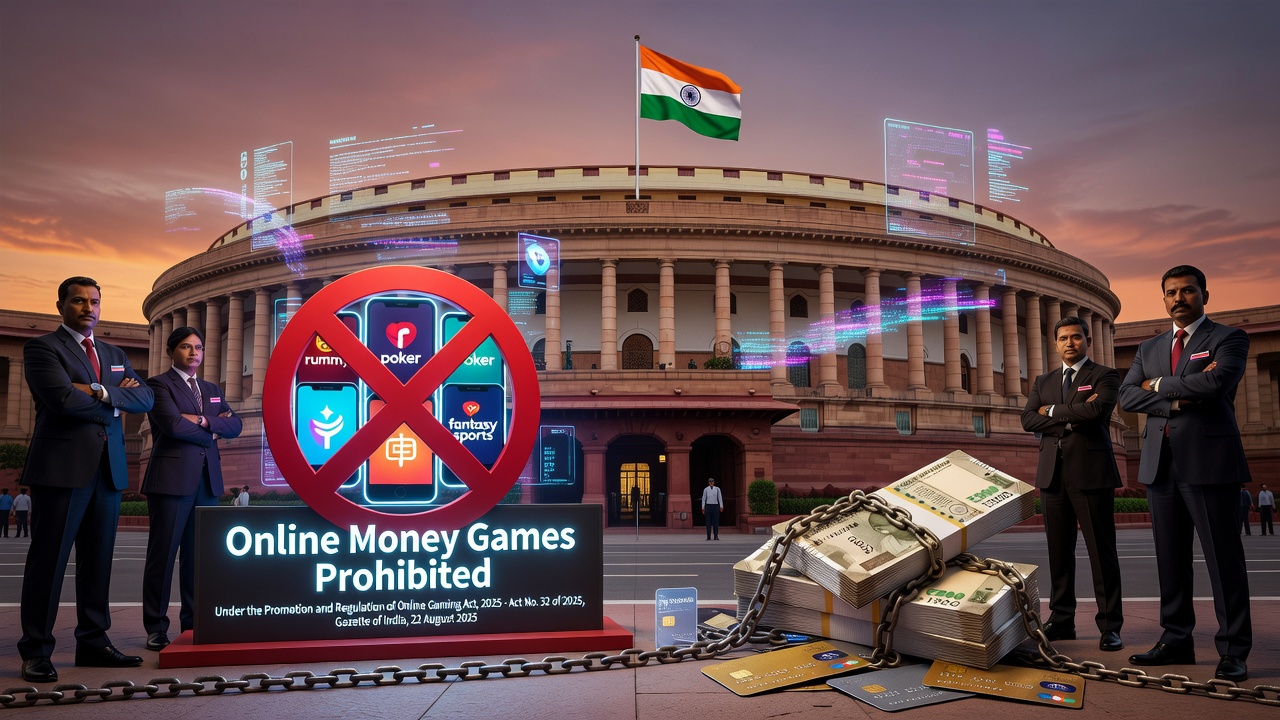
India has drawn a hard legal line between skill-based entertainment and gambling for cash. The Promotion and Regulation of Online Gaming Act, 2025 - Act No. 32 of 2025, published in the Gazette of India on 22 August 2025 - prohibits online money games nationwide while carving out protected space for e-sports and social gaming. The Rules that operationalise the Act take effect on 1 May 2026, giving platforms, banks and advertisers a defined runway to comply or exit.
A definition that ends the skill-versus-chance debate
For years, operators of rummy, poker and fantasy sports platforms in India relied on a legal distinction: games of skill were treated differently from games of chance under older gambling statutes. The new Act removes that argument entirely. Section 2 defines an "online money game" as any game - skill, chance, or both - played by paying a fee or staking money in expectation of winning money or other enrichment. Once real money changes hands with a chance of financial return, the game falls under the prohibition, regardless of how much skill is involved. E-sports are explicitly excluded, provided they are registered with the new regulator.
Three groups, two futures
The law sorts digital games into three categories, each with a different fate under Indian law.
- Online money games: prohibited outright - offering, advertising or financing them is a criminal offence.
- E-sports: actively promoted, subject to registration with the Online Gaming Authority of India.
- Online social games: promoted, so long as no money is staked for a chance of money back; registration applies only where the government separately notifies specific categories.
This structure signals where India wants its gaming industry to grow - competitive, skill-recognised e-sports and casual social play - while shutting the door on real-money wagering formats that have proliferated through mobile apps.
Liability runs through the whole payment chain
The Act does not prosecute players directly. Its force falls on three groups: those who offer or help offer an online money game, those who advertise or induce participation, and those who facilitate payments - banks, financial institutions and intermediaries. Each offence carries prison terms of up to three years and fines reaching ₹1 crore, with repeat offenders facing mandatory minimum sentences and higher fines. Offences tied to offering the service or processing its payments are cognizable and non-bailable, meaning police can arrest without a warrant, and company directors or officers can be held personally liable. Authorised officers also have power to enter, search and seize across "physical or digital" premises.
For ordinary users, this matters even without direct liability: since banks and payment processors are barred from facilitating transactions tied to prohibited games, deposits and withdrawals linked to such platforms can be blocked or reversed without warning.
Enforcement tools beyond the courtroom
The Act gives regulators a faster lever than prosecution. Under Section 14, any online money gaming service that breaches the advertising, offering or payment provisions can have its content blocked under the Information Technology Act, 2000 - a mechanism already familiar from website takedowns in other contexts. The Online Gaming Authority of India, an attached office under the Ministry of Electronics and Information Technology, will determine within roughly 90 days whether a given game qualifies as an online money game, and will maintain a public list. It also runs a grievance and appeal system, with users able to escalate unresolved complaints within 30 days, and a further appeal available to the Ministry's Secretary.
The practical effect is a compliance regime that pressures the entire ecosystem - operators, advertisers, payment rails and app stores - rather than relying solely on individual prosecutions. Anyone uncertain about where a specific product or platform stands under the new framework should seek independent legal advice rather than assume continuity with pre-2025 practice.