
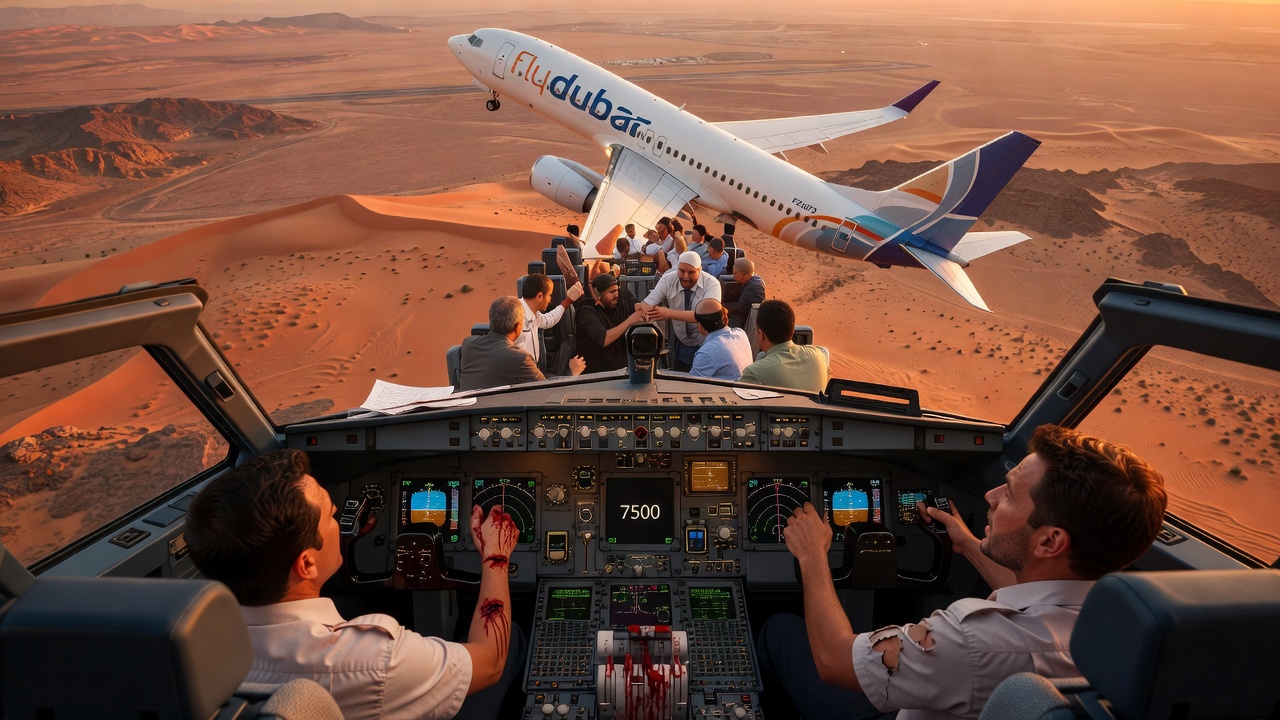
A Flydubai flight bound for Tel Aviv was forced into a dramatic diversion after a violent struggle broke out between the two pilots operating the aircraft. Flight FZ1073 transmitted squawk code 7500, the internationally recognised signal for unlawful interference, before plunging nearly 14,000 feet in under 30 seconds and landing safely in Tabuk, Saudi Arabia. The incident has since drawn attention from Israeli officials, who have characterised it as a serious security matter still under active investigation.
What the Emergency Code Reveals
Squawk 7500 is not used lightly. Pilots reserve it for situations involving hijacking or unlawful interference, distinct from the codes used for general mechanical failure or medical emergencies. Its activation during FZ1073 signalled to air traffic control across multiple jurisdictions that the flight required immediate coordination, including rerouting and ground security preparation. The rapid altitude loss reported - a descent of thousands of feet within half a minute - is consistent with an urgent attempt to regain control of the aircraft or respond to a struggle in the flight deck, rather than a standard descent profile.
According to reports, one pilot was stabbed during the confrontation, and it was passengers and cabin crew who intervened to subdue the individual responsible, allowing the aircraft to be brought down safely. The decision to divert to Tabuk rather than continue toward Tel Aviv or return to Dubai reflects standard aviation protocol: crews are trained to land at the nearest suitable airfield once a security threat is identified, prioritising passenger safety over the original flight plan.
Political Reaction and the Investigation Ahead
Israeli Prime Minister Benjamin Netanyahu described the episode as a highly severe security situation, framing it as an attempted terror attack and alleging that the co-pilot sought to crash the aircraft. Israeli politician Sharon Haskel confirmed that the matter is now under investigation by authorities in both Saudi Arabia and the United Arab Emirates, underscoring the cross-border complexity of the case. Any credible findings will need to establish motive, intent, and whether this was an isolated act or part of a broader pattern of concern within cockpit security protocols.
Commercial aviation operates on a principle of mutual trust between flight crew members, reinforced by strict vetting, psychological screening, and procedural safeguards introduced after previous incidents involving pilot misconduct. When that trust fails mid-flight, the consequences are immediate and severe, as this case demonstrates. Airlines and regulators will likely scrutinise crew pairing protocols, in-flight intervention procedures, and the adequacy of existing screening measures in the wake of this event.
Passenger Safety and the Road to Tel Aviv
Passengers stranded in Tabuk were later transported on a rescue flight that landed safely in Tel Aviv, bringing the immediate crisis to a close. The episode nonetheless raises broader questions about airline emergency response, the resilience of flight deck security, and how carriers communicate with passengers and families during unfolding incidents of this nature. For an industry built on predictability and procedure, an event of this kind is a reminder that safety systems are tested not only by mechanical failure or weather, but by human behaviour under extreme pressure.