
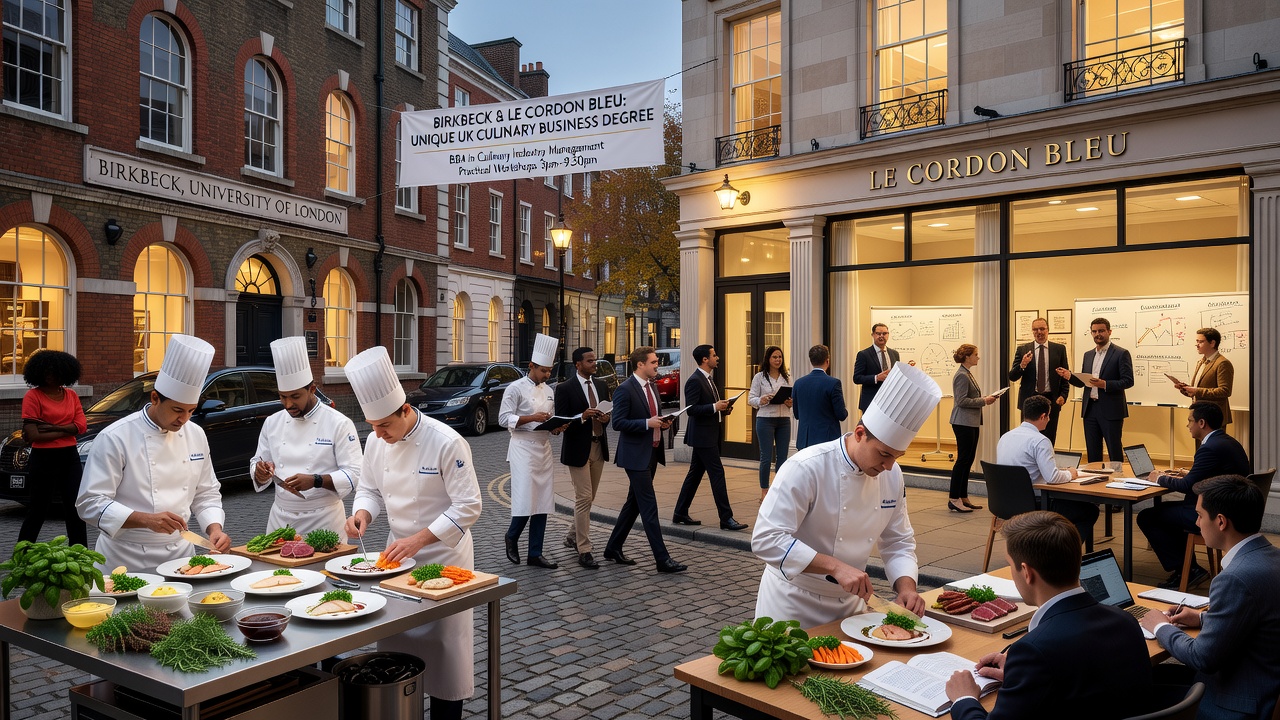
A new undergraduate pathway is attempting to close a longstanding gap between kitchen craft and commercial management. Birkbeck, part of the University of London, has partnered with Le Cordon Bleu Culinary Arts Institute to deliver a BBA in Culinary Industry Management, which the two institutions describe as the only course of its kind in the UK. The degree sits at the intersection of two fields that rarely share a classroom: professional culinary training and formal business education.
Why combine a kitchen and a business school
Food businesses, from independent restaurants to large hospitality groups, are commercial operations as much as creative ones. A chef who understands costing, supply chains, staff management and business strategy is better equipped to run a kitchen profitably, not just competently. This course structures its teaching around that reality. Business and management modules are delivered by Birkbeck's academic staff through lectures and seminars, while professional culinary modules take place at Le Cordon Bleu through demonstrations, workshops and practical sessions. The result is a curriculum that treats cooking skill and business literacy as equally necessary, rather than treating management as an afterthought bolted onto a vocational qualification.
How the timetable actually works
The course is full-time but structured around evening and some daytime study, a format aimed at students who may be balancing other commitments. In the first year, culinary classes at Le Cordon Bleu run from 3pm to 9.30pm, while evening sessions in later years typically run from 6.30pm to 9.30pm. Students generally attend two classes a week at each institution, with Le Cordon Bleu and Birkbeck located close enough together in London to allow movement between sites within a single teaching day. The academic year runs from October to July.
- Core structure: two culinary sessions at Le Cordon Bleu and two business sessions at Birkbeck weekly
- Industry exposure through site visits and guest speakers from hospitality and food service
- A paid or unpaid internship placed between the first and second years
- Optional Foundation Year for applicants without standard entry qualifications
Entry routes and who the course is designed for
Standard entry for the three-year route sits at 96 to 112 UCAS points, broadly equivalent to grades CCC to BBC at A-level, while the four-year route including a Foundation Year requires 64 points. Birkbeck states it will also consider applicants without traditional qualifications, basing some decisions on prior work experience or an internal skills assessment. This flexibility matters in a sector where practical kitchen experience is often more immediately useful than exam results, though students without GCSE-level English and mathematics may be asked to sit a skills audit. International applicants require IELTS 6.5 or equivalent, and those needing a Student visa must study full-time and on campus, since online or part-time formats can affect visa eligibility.
What the qualification signals for the hospitality sector
Hospitality and food service remain industries with high operational turnover and tight margins, where management failures can undo strong culinary talent. A joint qualification of this kind reflects a broader shift in vocational education: technical skill is increasingly packaged alongside formal business training rather than taught in isolation. Membership of the Institute of Hospitality, offered free to students on this course, reinforces that positioning toward professional standards rather than purely craft-based training. For prospective students, the practical questions worth weighing are the same as with any vocational-business hybrid degree - the time commitment of combining two teaching sites, the demands of a summer internship, and whether a management-oriented qualification aligns with their longer-term career goals in food business ownership, operations or hospitality leadership.