
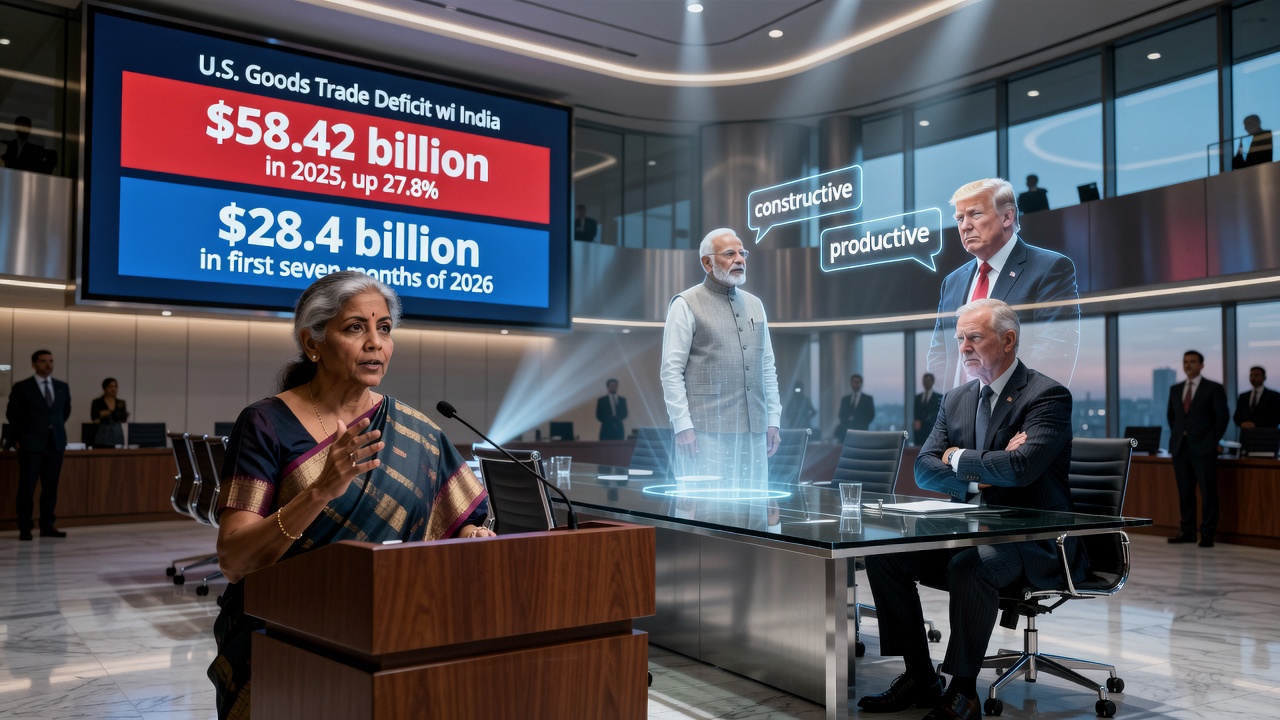
India's Finance Minister Nirmala Sitharaman has, for the first time, publicly conceded that negotiations with Washington over a bilateral trade deal have stalled. Speaking at the Munich Leaders Meeting in New Delhi on Monday, she said both sides appear to have reached a "plateau beyond which giving or taking might be very very difficult." The remark marks a notable shift in tone from a government that has until now projected steady optimism about closing an agreement with the United States.
A Deal That Keeps Slipping
Sitharaman's comments followed similar caution from U.S. Trade Representative Jamieson Greer, who said last week that an agreement was not "imminent," even as talks continued. The timing matters: Prime Minister Narendra Modi and President Donald Trump spoke by phone recently, reviewing trade, defense, energy and critical technology cooperation. Greer called the call "constructive" and Modi described it as "productive," but Trump himself offered no comment - an absence that has not gone unnoticed in trade circles.
The core sticking point, according to Sitharaman, is Washington's insistence on using the trade imbalance as the primary benchmark for concessions. The U.S. goods trade deficit with India stood at $58.42 billion in 2025, up 27.8% from the previous year. In just the first seven months of 2026, the gap had already reached $28.4 billion. Sitharaman questioned how far negotiators can realistically go when imbalance reduction becomes the dominant criterion, rather than one factor among many.
Tariffs, Pharma and Smartphones in the Balance
Indian exports to the U.S. currently face a 10% tariff, a rate set following the conclusion of a U.S. investigation into forced-labor practices across 60 countries. India notes that a substantial portion of its exports - including generic pharmaceuticals and smartphones - fall outside this duty's scope, offering some insulation. Still, Trump's February announcement of an interim arrangement, under which India agreed to "BUY AMERICAN" at a higher level, suggests Washington expects more than tariff adjustments; it wants structural shifts in purchasing behavior.
India, for its part, has been pushing for preferential tariff treatment to keep its exports competitive against rivals in Southeast Asia and elsewhere. Without a deal, that competitive position could erode quickly if other countries secure more favorable terms first.
Why a Stalemate Carries Real Costs
Mark Linscott, a former assistant U.S. trade representative now advising the U.S.-India Strategic Partnership Forum, framed the stakes bluntly: both countries stand to lose if no deal is finalized. U.S. exporters already face steeper tariffs entering the Indian market than India faces entering the American one. Meanwhile, India risks falling behind if peer economies lock in better terms with Washington while New Delhi remains stuck in negotiation limbo.
- The U.S. market remains critical to India's export growth, particularly in pharmaceuticals and electronics.
- A prolonged plateau could push Washington toward unilateral tariff action rather than negotiated compromise.
- India's insistence on preferential access conflicts with the U.S. focus on narrowing the deficit through volume-based concessions.
What Sitharaman's acknowledgment ultimately signals is a recalibration of expectations. Trade deals built around asymmetric priorities - one side fixated on imbalance, the other on market access - tend to stall exactly where this one has: close enough to seem achievable, far enough to remain elusive.