
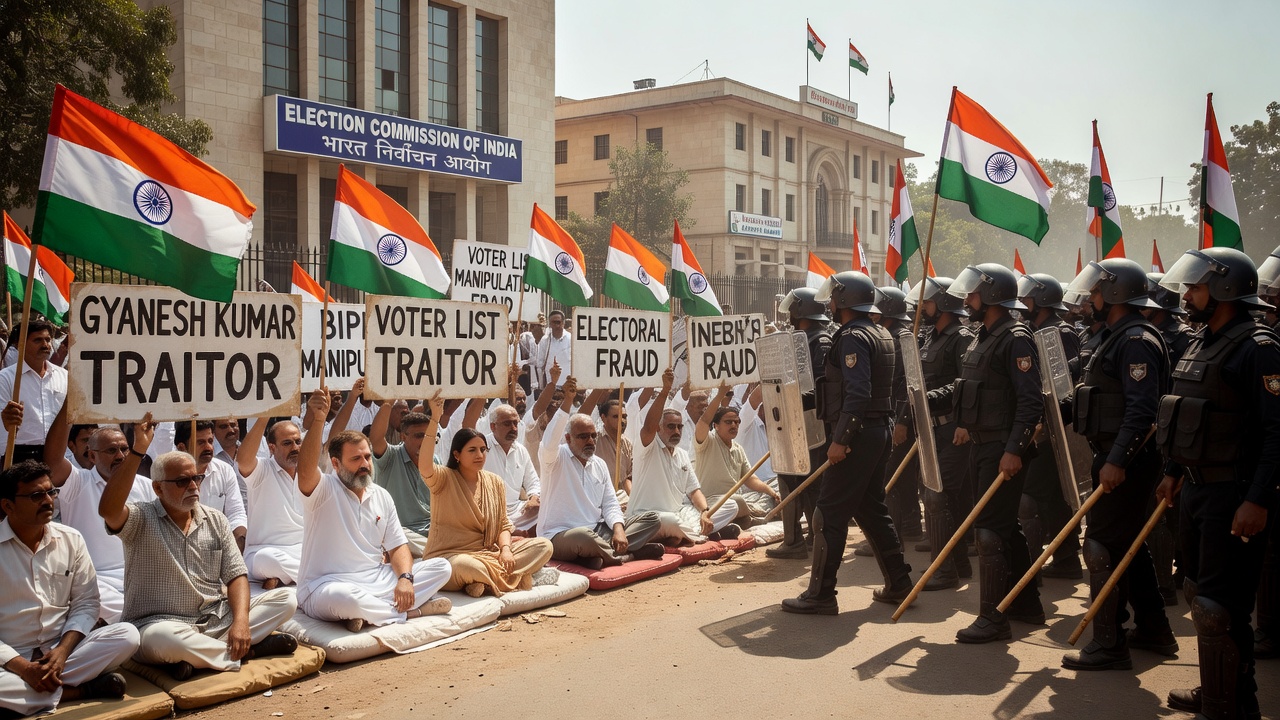
Delhi police dismantled an opposition sit-in outside the Election Commission of India's headquarters on Tuesday, briefly detaining Congress leader Rahul Gandhi, his sister Priyanka Vadra and dozens of other lawmakers. The confrontation capped a day of marches and placard-waving protests demanding the resignation of Chief Election Commissioner Gyanesh Kumar, after reports surfaced of internal disagreement within the commission over how voter lists were updated.
What Sparked the Standoff
The unrest traces back to a newspaper report alleging friction inside the Election Commission over revisions to voter registration data. Congress and allied parties argue those revisions tilt the electoral rolls in favour of Prime Minister Narendra Modi's Bharatiya Janata Party. Reuters has not independently verified the original report, and the commission itself has not responded directly to the claims, though both the ECI and the BJP have rejected the accusations as unfounded. The lack of public clarification from Kumar has left the dispute unresolved and fuelled further protest.
A Test of Institutional Trust
Election commissions function as the backbone of democratic legitimacy - their credibility rests on being seen as independent from the government of the day, even when their leadership is appointed by that government. When opposition parties accuse an election chief of partisan conduct, the damage is not confined to one election cycle; it can erode public confidence in the entire electoral apparatus. That is why Congress President Mallikarjun Kharge framed the protest in existential terms, telling reporters the commission had become "a puppet in the hands of the government" and that the fight was about preserving democratic process itself.
This is not an isolated flashpoint. The demonstrations echo a wider pattern of youth-led and opposition mobilisation that has challenged Modi's government in recent months, including protests earlier this year that preceded the resignation of his education minister over exam paper leaks. The involvement of the youth-driven "cockroach" movement alongside established political lawmakers signals that grievances over institutional transparency are drawing support beyond traditional party lines.
How the Day Unfolded
Lawmakers marched from parliament toward the ECI compound, carrying national flags and placards branding Kumar a "traitor" and accusing the BJP of disenfranchising voters. Security forces in riot gear blocked their entry, prompting the group to sit on mattresses in the adjoining state broadcaster's compound. The commission later said it offered to receive a written memorandum through one of its officers, an offer the lawmakers declined, insisting on a direct meeting with commissioners themselves. Talks over a late-evening meeting location reportedly broke down over procedural disagreements, after which police moved in and detained the protesters before releasing them.
- Protesters demanded Kumar's resignation over alleged bias in voter list revisions.
- The Election Commission and BJP have denied any manipulation.
- Reuters could not verify the original newspaper report on internal ECI disagreements.
- Gandhi and other lawmakers were detained and later released without charge, according to Congress.
Why It Matters Beyond This Protest
Disputes over voter roll integrity strike at a sensitive nerve in any democracy, particularly one as large and complex as India's, where even small administrative errors can affect millions of eligible voters. Whether or not the specific allegations hold up, the episode underscores how electoral administration has become a frontline political battleground, with each side using accusations of institutional capture to mobilise supporters ahead of future contests. For Modi's government, managing these recurring street challenges while defending the commission's independence will likely remain a recurring test through the rest of his third term.