
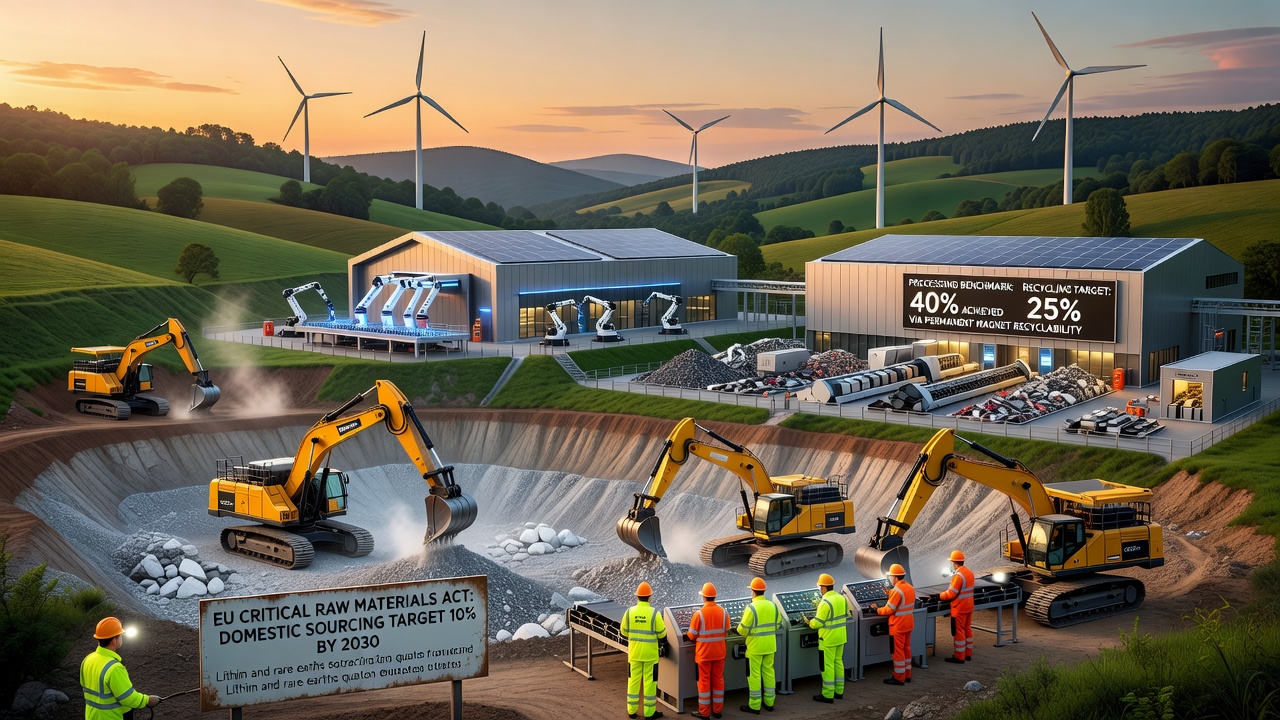
Europe's clean energy transition and digital ambitions rest on materials it barely produces itself. The Critical Raw Materials Act, adopted as part of the Green Deal Industrial Plan, sets binding targets to reduce that exposure and rebuild domestic capacity across mining, processing and recycling. It arrives as demand projections for materials like lithium and rare earths point to increases that current supply chains were never built to handle.
Why Dependency Became a Strategic Liability
Wind turbines, electric vehicles, semiconductors and defence systems all depend on a narrow set of raw materials that Europe imports, often from a single external supplier. That concentration leaves entire industrial sectors exposed to a single point of failure - a trade dispute, an export restriction, or a logistical disruption elsewhere in the world can ripple straight into European factories. The Act treats this not as a hypothetical risk but as a structural weakness in the single market that needs correcting before demand accelerates further.
Targets, Timelines and Permitting Reform
Rather than relying on general ambition, the Regulation sets measurable benchmarks for the EU's own strategic raw materials value chain by 2030:
- At least 10% of annual consumption sourced from domestic extraction
- At least 40% processed within the EU
- At least 25% met through recycling
- No more than 65% of consumption sourced from any single third country
To make these targets realistic, the Act shortens and simplifies permitting. Strategic projects can move through extraction approval within 27 months and processing or recycling approval within 15 months, coordinated through a single national contact point in each member state. Environmental and social safeguards remain in place - the reform targets bureaucratic delay, not oversight itself.
Diversifying Trade Without Cutting Ties
Faster domestic permitting is only part of the strategy. The accompanying communication commits the EU to deeper trade partnerships, use of the Global Gateway initiative for infrastructure investment, and a proposed export credit facility to de-risk investment in partner countries. The stated aim is mutual benefit: supporting economic development abroad while diversifying where Europe sources materials from, so that dependency on any one supplier does not simply shift from one country to another.
Circularity, Monitoring and Oversight
The Act also pushes member states to improve collection of critical raw material-rich waste, investigate recovery potential from extractive waste, and set recyclability requirements for products such as permanent magnets. A new European Critical Raw Materials Board, bringing together the Commission and national governments, will oversee implementation and coordinate stress-testing of supply chains, alongside risk-preparedness obligations placed on large manufacturers of strategic technologies. Together, these mechanisms are designed to give Brussels earlier warning of supply shocks rather than reacting to them after the fact.