
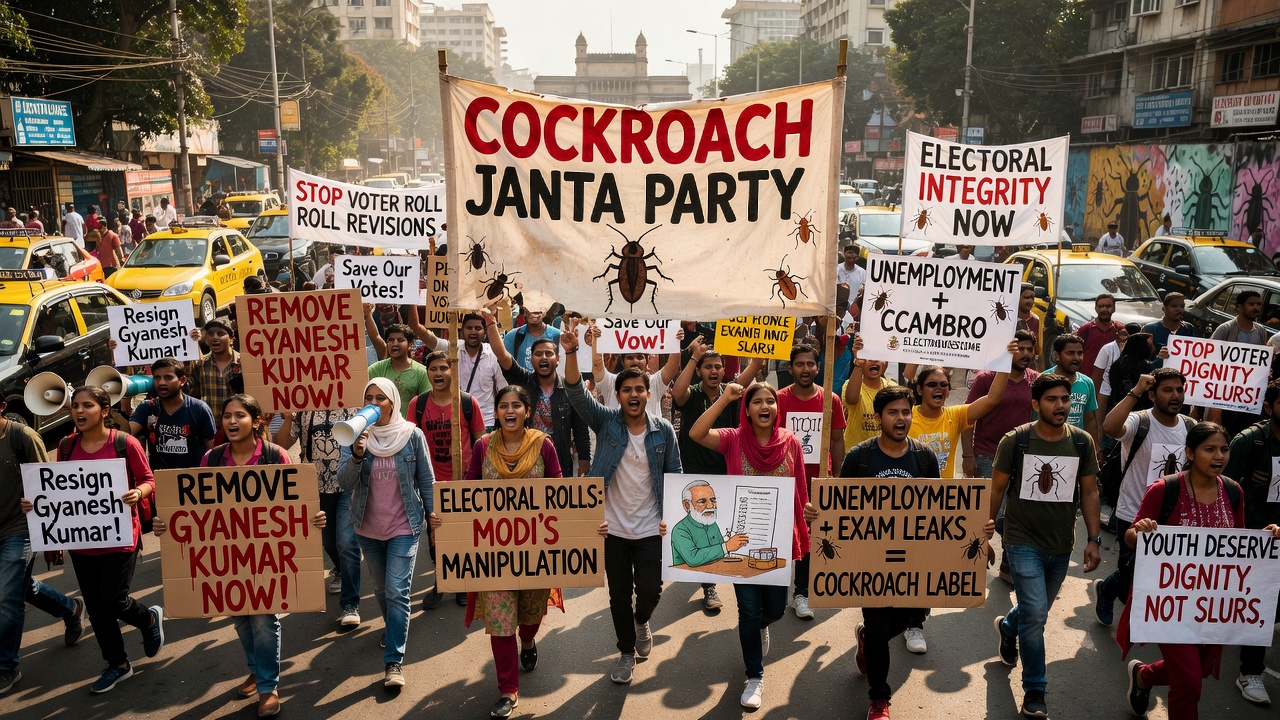
Hundreds of protesters gathered in Mumbai on Friday under the banner of the Cockroach Janta Party, launching a nationwide campaign against revisions to India's electoral rolls. The demonstrators argue the changes disproportionately strip eligible voters from the registry in ways that favor Prime Minister Narendra Modi's Bharatiya Janata Party. The protest is the latest flashpoint in a year marked by youth-led mobilization against institutions once considered largely immune to public challenge.
A Movement Born From Grievance
The Cockroach Janta Party did not emerge from conventional political organizing. It grew out of online anger over unemployment and leaked examination papers, and took its name after India's chief justice reportedly described unemployed youth and online activists as "cockroaches." That movement already forced the resignation of a government minister after exam-leak protests gained traction. Its pivot to electoral integrity signals an expanding appetite among young Indians to contest institutions beyond the education system.
Why the Voter Rolls Matter
At the center of the dispute is a nationwide voter-verification exercise that the Election Commission says is meant to purge duplicate, deceased, or ineligible names from the rolls. Critics, including opposition parties, contend the process has removed millions of legitimate voters, raising concerns about the integrity of future elections. The Election Commission has pushed back, insisting that internal disagreements among officials - including repeated concerns reportedly raised by two of its own deputies over the past ten months - reflect normal deliberation rather than dysfunction. Pressure has concentrated on commission chief Gyanesh Kumar, who has not publicly responded to the criticism.
In an apparent attempt to defuse tension, the commission on Friday instructed officials to register newly eligible voters and those omitted from the rolls. Whether that administrative gesture satisfies protesters remains uncertain, particularly as opposition parties under the INDIA alliance prepare their own march on the commission's Delhi office.
Divergent Responses in Mumbai and Delhi
The contrast between the two cities was notable. Mumbai's protest proceeded with chanting crowds and placards demanding Kumar's resignation. In Delhi, a separate group of student demonstrators was prevented from assembling altogether, with police loading protesters onto buses and shutting nearby metro stations. That disparity underscores the uneven latitude authorities have granted to dissent depending on location and organizing group.
What This Signals Politically
Analysts note that after more than a decade in power, Modi's government faces a harder task labeling youth-led dissent as fringe or foreign-influenced, given its domestic, grassroots character. With young people representing a substantial share of the population, sustained questioning of institutional credibility - even when protests are sporadic and city-specific - carries longer-term political weight that extends well beyond this single campaign.