
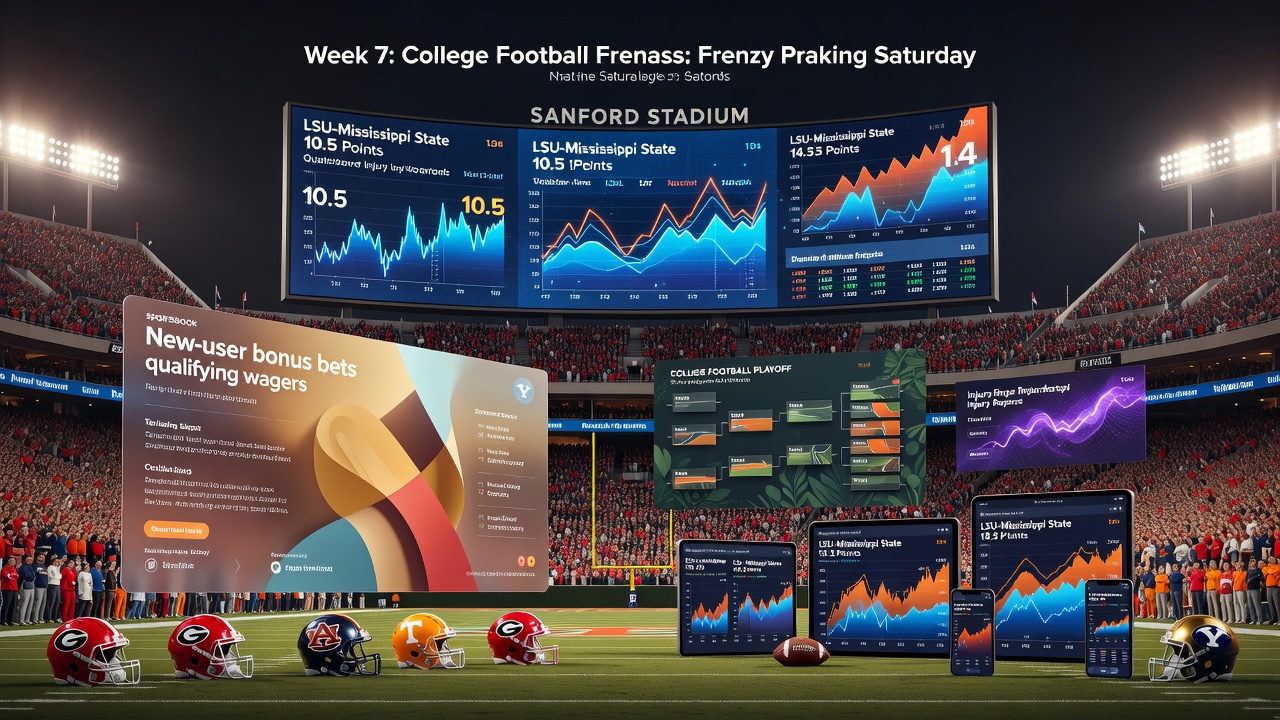
Six ranked matchups headline Saturday's college football schedule, and the betting market has responded with lines that shifted notably as injury news and recent results reshaped expectations. No. 1 Georgia hosting Auburn, No. 6 Alabama traveling to No. 14 Tennessee, and No. 2 Notre Dame facing No. 8 BYU all carry significant point spreads that reflect how quickly perceived power rankings can move midseason. The volume of nationally ranked teams in action has also made this a peak week for sportsbook promotional activity, with operators competing for new customers through sign-up offers tied to the slate.
Why the odds moved so sharply this week
Point spreads on games like LSU-Mississippi State illustrate how sportsbooks react to real-time information. A line that opened near 10.5 points moved to 14 after reports surfaced that Mississippi State's starting quarterback was questionable with injury. That kind of shift isn't arbitrary - it reflects sportsbooks adjusting to anticipated bettor behavior and perceived talent gaps, while also managing their own exposure. Bettors who track line movement rather than just the final number often get a clearer read on what the market believes versus what a single sportsbook opened with.
Georgia's jump to No. 1 after beating Alabama, paired with Texas's loss to Oklahoma, shows how quickly the top of the rankings can reorganize in a 12-team College Football Playoff era. That volatility feeds betting interest, since markets with more uncertainty - upset potential, quarterback injuries, coaching tendencies - tend to draw heavier action across spreads, totals, and moneylines.
What new sportsbook promotions actually offer
Heading into this weekend, several licensed operators are running new-user promotions tied to the college football calendar. These typically take the form of bonus bets issued after an initial qualifying wager, sometimes bundled with unrelated perks like a streaming subscription. It's worth understanding the mechanics: bonus bets usually carry wagering restrictions, expiration windows, and are not redeemable as cash in the way a deposit is. They function as a customer acquisition tool for operators competing in a crowded, regulated market - not as free money without conditions attached.
- Bonus bets generally require the stake to be wagered again before any winnings can be withdrawn
- Promotional terms vary significantly by state due to differing gambling regulations
- No promotional structure changes the underlying odds or house edge on any given bet
The broader regulatory and consumer context
Online sports betting is now legal in more than 30 states plus Washington D.C. and Puerto Rico, a landscape that has expanded rapidly since the 2018 Supreme Court decision that opened the door to state-level legalization. That expansion has brought real consumer protections - licensing requirements, age verification, and self-exclusion tools among them - but it has also normalized sports betting as a mainstream entertainment product, often marketed heavily around marquee games like a ranked conference matchup.
For readers following Week 7's lines, the matchups themselves carry genuine competitive stakes beyond the betting market: playoff positioning, conference championship implications, and rivalry history all factor into why spreads on games like Georgia-Auburn or Alabama-Tennessee are set where they are. But it's worth remembering that a point spread reflects a sportsbook's attempt to balance action on both sides, not a guarantee of outcome. No promotional offer or statistical trend changes that fundamental uncertainty, and bettors should treat any wager as entertainment spending rather than a reliable income strategy.