
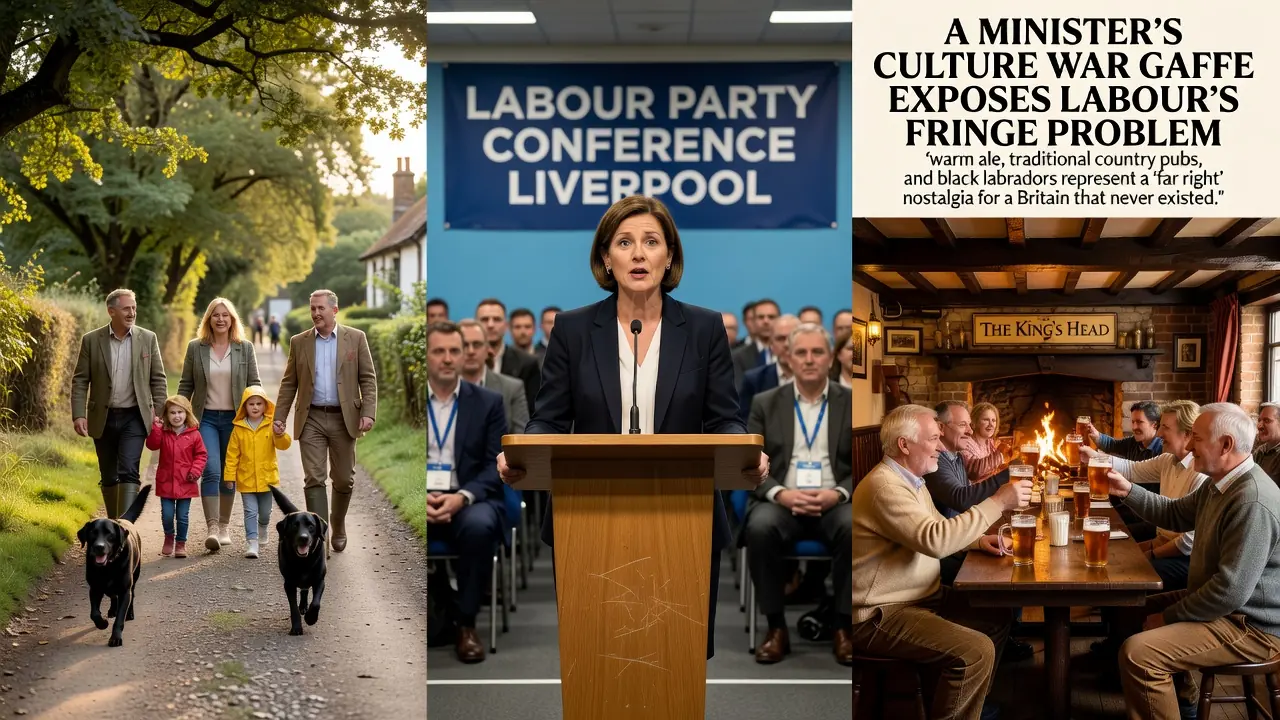
A government minister stood up at the Labour Party Conference in Liverpool and declared that warm ale, country pubs and black labradors conjure a "far right" nostalgia for a Britain that never existed. The remark, made by nature minister Jenny Riddell-Carpenter, was intended as cultural commentary. It landed instead as a case study in how conference fringe events can produce statements wildly detached from how most people actually live.
When Political Rhetoric Loses the Room
Party conferences exist partly to let politicians test ideas away from the scrutiny of a general election campaign. That freedom can produce genuine policy innovation. It can also produce moments where a minister, reaching for a point about identity and belonging, instead insults a huge swathe of ordinary voters who enjoy a pint, a dog and a Sunday walk without any accompanying ideology. Riddell-Carpenter joins a recent lineage of Labour figures whose fringe remarks have overshadowed substantive debate, from calls to regulate speech "to make it free" to campaigns built around slogans rather than policy. The pattern matters because it feeds a public perception that governing parties are more interested in signalling values than solving problems.
Private Members' Clubs Chase Novelty Over Substance
Elsewhere in London, the private members' club market is showing its own signs of excess. The Pembroke, a new Belgravia venue reportedly built on a budget approaching £100m, is said to be hiring a dedicated butter sommelier. Wine and cigar specialists are long-established fixtures of high-end clubs; a role built entirely around dairy condiments suggests a market straining to differentiate itself through gimmick rather than genuine service quality. This matters beyond the amusement value. London's exclusive club scene has expanded rapidly in recent years, competing for a wealthy clientele that is simultaneously facing a tightening UK tax environment and, for some, considering relocation abroad. A novelty hire aimed at headlines rather than member experience may say more about marketing strategy than culinary ambition.
Tourist Traps and the Shadow Economy
A more serious thread concerns reports that ice cream vans stationed on Westminster Bridge, charging tourists several times the national average price for a simple cone, are allegedly linked to organised crime operations. If accurate, this illustrates how legitimate-looking street commerce can mask illicit financial activity, a concern regulators and law enforcement take seriously regardless of the product being sold. Consumers rarely question a street vendor's receipts, which is precisely why cash-heavy, high-footfall tourist pitches can become attractive fronts. It is a reminder that consumer protection concerns are not confined to obviously regulated sectors like gambling or finance; they extend to everyday transactions where price transparency and provenance go unchecked.
A Note on What Still Works
Amid the excess and the gaffes, some things endure through quality rather than spectacle. Franco's on Jermyn Street, open since 1945, remains a benchmark for understated excellence in London dining, its Vitello Tonnato a reminder that good execution of a simple idea usually outperforms novelty. The contrast with the butter sommelier is instructive: longevity in hospitality, as in politics, tends to reward substance over stunt.