
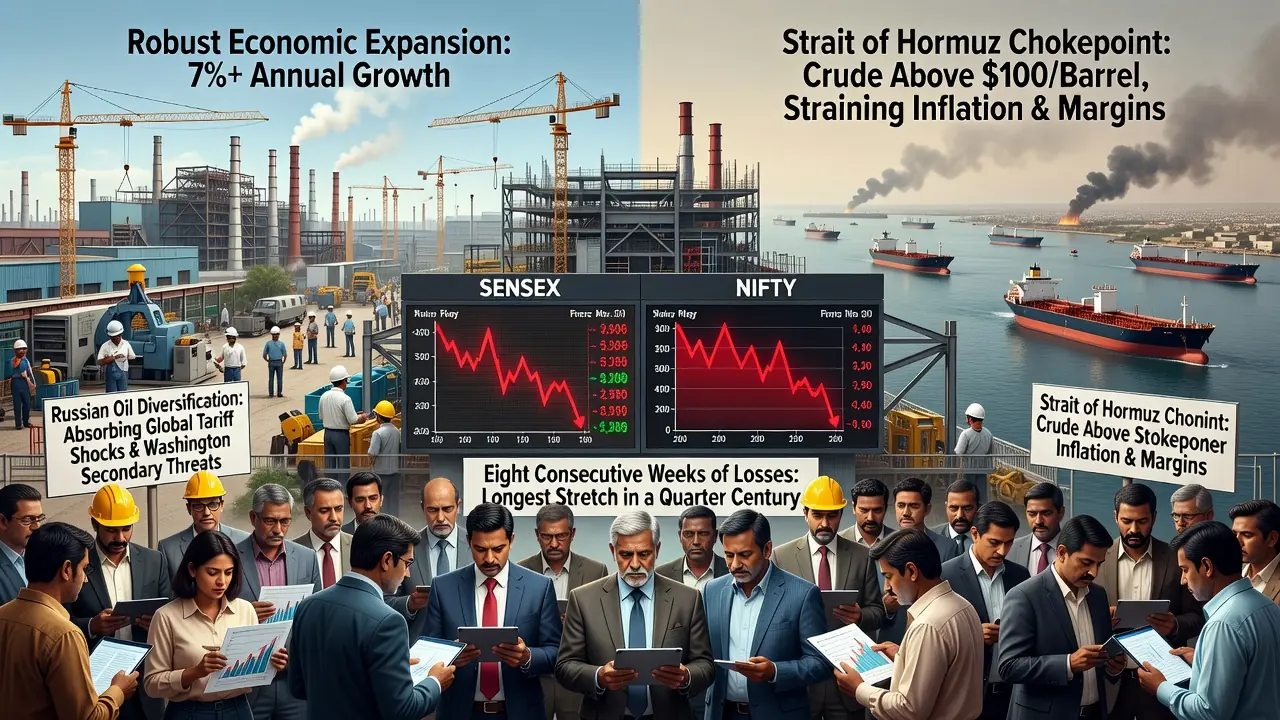
India's economy continues to expand at more than 7% a year, a pace that outstrips every other major nation even as it absorbs oil-price shocks, elevated global interest rates and tariff disputes. Yet its equity markets have told a strikingly different story in 2026, with the Sensex and Nifty indices posting eight consecutive weeks of losses - the longest such stretch in a quarter century. The disconnect between a thriving real economy and a struggling stock market has left millions of retail investors nursing losses and raised hard questions about what is actually driving capital allocation decisions worldwide.
Energy and Interest Rates Squeeze Sentiment
Much of the pressure traces back to the Strait of Hormuz disruption, now in its eighth month, which has kept crude oil prices elevated well beyond what markets can comfortably absorb. India imports the overwhelming majority of its oil, and a meaningful share of that supply transits the strait, making the country unusually exposed to this specific chokepoint. Fund managers note that crude above $100 a barrel begins to strain inflation, corporate margins and broader macroeconomic stability, even as Delhi has tried to diversify its sources, including toward Russian supply, a move complicated by the threat of secondary tariffs from Washington.
Layered on top of this is a global interest-rate environment that has made US government bonds - effectively risk-free assets - yield levels last seen decades ago. When safe returns rise this much, capital naturally migrates away from emerging-market equities, including India's, regardless of how fast the underlying economy is growing.
A Weaker Currency and Valuation Reset
For foreign investors, the pain has been compounded by rupee depreciation. Returns that might look respectable in local currency terms shrink considerably once converted back to dollars, and the Nifty's annualised dollar return over the past decade has been modest compared with rival markets. This currency drag, combined with a broad market correction, has eroded the valuation premium Indian equities once commanded over other emerging economies. Stocks are now cheaper relative to their own history, but they remain expensive relative to earnings - particularly next to markets like South Korea and Taiwan, whose listed companies have captured outsized profits from the global artificial intelligence boom.
The Missing Technology Dividend
That AI gap may be the most structural problem of all. India's largest listed companies are, in the view of several analysts, built around legacy sectors rather than frontier technology, often relying on policy protection rather than competing globally. Its smaller, more innovative firms have not yet reached the scale needed to draw serious foreign institutional interest. Unlike the United States or China, India has not produced a globally dominant AI firm, and that is precisely where the most lucrative profit pools in this technology cycle currently sit. Early activity in space, defence, semiconductors and deep-tech signals potential, but remains too small to shift capital flows meaningfully.
Domestic Savers Carry the Weight
What has kept Indian markets from falling further is not foreign money but domestic money. Mutual fund assets under management have grown enormously over the past decade, and the number of individual Indians investing in stocks and funds has more than tripled. This retail base has continued channelling monthly contributions into the market even as foreign portfolio investors have pulled out tens of billions of dollars over the past two years. That resilience is notable, but it also means ordinary households - already contending with a soft job market and persistent inflation - are now absorbing losses in what was supposed to be a source of long-term savings growth.
Whether that patience holds will depend on upcoming corporate earnings, the trajectory of oil prices, and any easing in geopolitical tensions. For now, India's growth story and its stock market are moving on separate tracks, a reminder that macroeconomic strength and investor returns do not always travel together.